Evening.Aava, for iPhone
Train the voice in your head. In your own voice.
An iPhone app for the way you talk to yourself: you record short beliefs in your own voice — the kind of sentence you'd say to a friend — and hear them back. Four weeks, twenty beliefs, about two minutes a day.
Free to download·Three-day free trial·iPhone
Recordings never leave your iPhone.
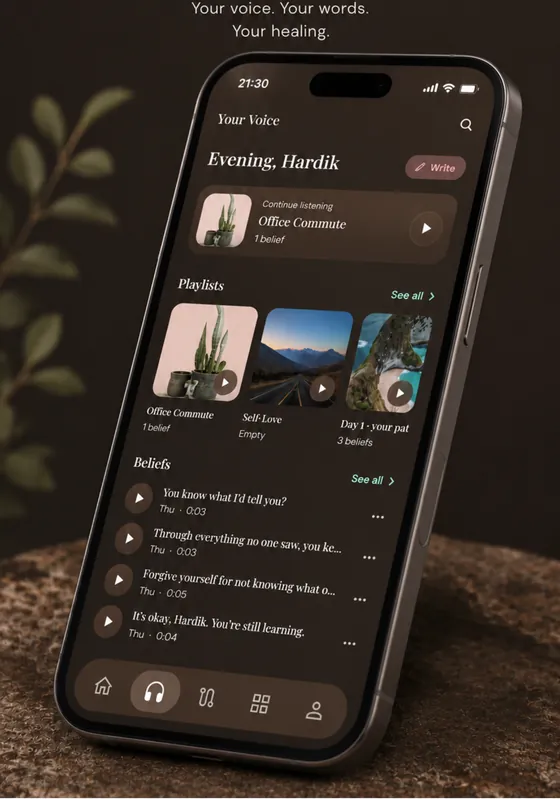
Forgive yourself for not knowing what only time could teach you.
I'm harder on myself than I'd ever be on anyone else.
Most people who'd say that sentence are, from the outside, doing fine. Careful work, decent at the job, patient with colleagues, generous with friends. The harshness is entirely internal — and it has a specific sound.
If you've ever worked somewhere with a review cycle, you know it: it borrows the phrasing. If you build alone now, you know it never left. It just stopped having a calendar.
Same person. Same facts. The only thing that changed is who the sentence was addressed to.
You already have the kinder sentence — you use it on everyone else, fluently, without thinking. Aava is a way to say it to yourself: out loud, in your own voice, on a schedule, so it gets some of the practice the other one has had for years.
The other reason it matters
The way I speak to myself becomes how I am in public.
You already know what to say. You've just only ever said it to other people.
Aava turns that around, in four steps.
-
1
Get the sentence
Each day on a path hands you one belief, already written, one sentence long. For something specific that's going on, Aava asks a single question instead — how would you talk to a friend going through this? — and you write what you'd say.
Writing it for a friend first isn't a trick. People reason more clearly about other people's situations than their own; this borrows that clarity before it borrows your voice.
-
2
Record it
Say it out loud, in your own voice. A belief takes three to five seconds. The recording is stored on your phone and stays there.
-
3
Hear it back
Play it. It's the one voice you can't file under “advice”.
-
4
Come back tomorrow
About two minutes. Five days a week, then a rest day and a revision day, for four weeks. Then the path ends.
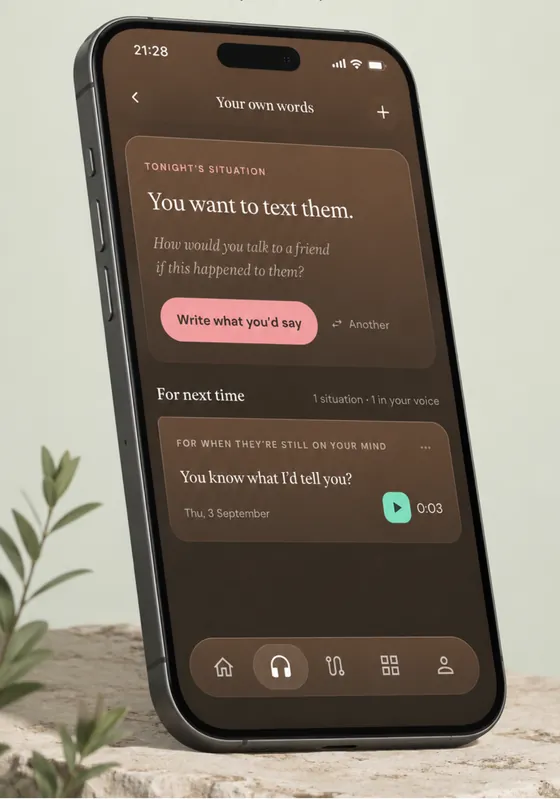
The question, on the screen it lives on.
In someone else's voice, it's advice. In yours, it's closer to memory.
That's the whole reason Aava makes you record it, instead of handing you a library of someone reading nicely. A stranger's voice saying something kind is easy to weigh, file and forget. Your own is harder to put down.
It's also why the critic is so convincing. It already speaks in your voice, with your vocabulary, and it has had years of practice. Aava doesn't try to out-argue it. It gives the other sentence the same voice, and the same repetition.
Someone else reading it
Advice.
You saying it
Closer to memory.
A path, not a feed.
Every path is four weeks: twenty beliefs, one a day, five days a week, with a rest day and a revision day in each. About two minutes a day. Then it ends — the way a course ends, not the way a feed does.
Start where it actually hurts.
Some of the paths:
Foundations·Boundaries·Steady·Momentum·Switch Off·
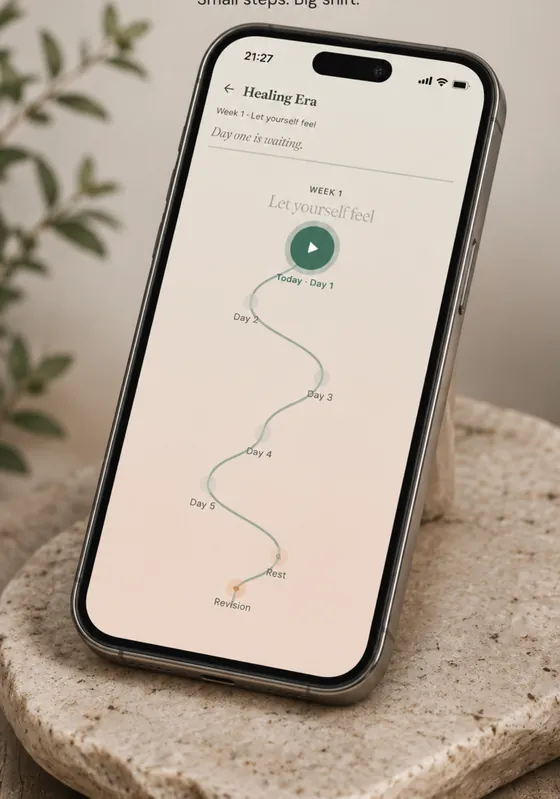
Week one of a path. Today is day one.
About hearing your own voice.
Most people don't like it, at first. The voice you hear from inside your head arrives partly through bone; a recording is the version everyone else has been hearing all along. It isn't worse. It's just not the one you're used to.
Does your recorded voice make you wince?
Then you're in good company, and you're the person this was built for. What you're hearing is unfamiliarity, not a verdict. Each recording is three to five seconds long, and you're the only one who will ever hear it.
Then you have a head start. The mechanic is exactly the same — you just get to the part where the kind sentence sounds like yours a little sooner.
The app asks you a version of this question when you first open it. Both answers are right.
It never leaves your phone.
Every recording is stored on your iPhone and stays there. Nothing is uploaded — not to us, not to anyone. There is no server that has heard your voice, because there is no server your voice goes to.
That's a deliberate trade. A person saying something private, in their own voice, is exactly the kind of thing that shouldn't be sitting on someone else's server.
I'm Hardik. I built Aava on my own — the design, the code, the words in it.
I built it because the way I talk to other people is not how I talk to myself. I'm harder on myself than I'd ever be on anyone else, and the way I speak to myself becomes how I am in public. So I made the thing I wanted: something short and finite, in my own voice, that never leaves my phone.
The recordings in the screenshots are mine. There's a note from me inside the app, too. If it isn't working for you, I'd rather hear that than anything else.
— Hardik
Formerly a software engineer at Amazon. Computer science at BITS Pilani, class of 2024. Writing this from Mumbai.
The questions people actually ask.
About self-talk first, and about the app second.
What is self-talk?
The running commentary you direct at yourself — the sentences in your head about what you did, what it meant, and what it says about you. It's mostly automatic, and it usually goes unnoticed until someone points at it.
It tends to have a recognisable tone and vocabulary. Often borrowed from a particular place: a manager, a review cycle, a parent.
What counts as negative self-talk?
The version that's harsher toward you than the facts warrant — and harsher than you'd ever be toward another person in the same situation.
A quick test: take the situation, put a friend in it, and notice whether the sentence you'd offer them differs from the one you offered yourself. If it does, the gap is the self-talk. Not the facts.
How do you stop negative self-talk?
Arguing with it directly tends not to work. It's fluent, it sounds like you, and it has had years of practice.
What works better is giving the other sentence the same conditions the critical one has had: your own voice, out loud, repeated. You're not deleting a voice. You're giving the other one enough repetition to be there when it's needed. That's the whole mechanic of this app.
Why record it instead of just reading it?
In someone else's voice, a kind sentence is advice — easy to weigh, file and forget. In yours, it sits closer to memory.
Saying something aloud is also a different act from thinking it. It's slower, it commits, and you hear it as sound rather than as thought.
How is this different from an affirmations app?
Affirmations are usually generic, aspirational, and read by someone else — statements of things that aren't true yet.
These are one sentence, in your own voice, drawn from what you'd actually say to a friend in a real situation. Closer to reframing than to aspiration. And it's finite: four weeks, then the path ends.
Is this therapy?
No. It's a practice app, not therapy, not counselling, and not treatment for depression, anxiety or anything else clinical. It doesn't diagnose and it isn't a substitute for professional care.
If what's going on is bigger than a habit of phrasing, a person is the right answer, not an app.
Where do the recordings go?
Nowhere. They're stored on your iPhone and stay there. Nothing is uploaded — not to us, not to anyone. There's no server that has heard your voice, because there's no server it goes to.
What does it cost?
Free to download, with a three-day free trial. After that it's $4.90 a week or $49.99 a year.
It's a standard App Store subscription — managed and cancelled in your Apple ID settings. Cancel before the trial ends and nothing is charged.
Is there an Android version?
Not right now. Aava is iPhone only.
Say it in your own voice.
Four weeks. Twenty beliefs. About two minutes a day. The first three days are free.
Free on the App Store·iPhone
Recordings never leave your iPhone.